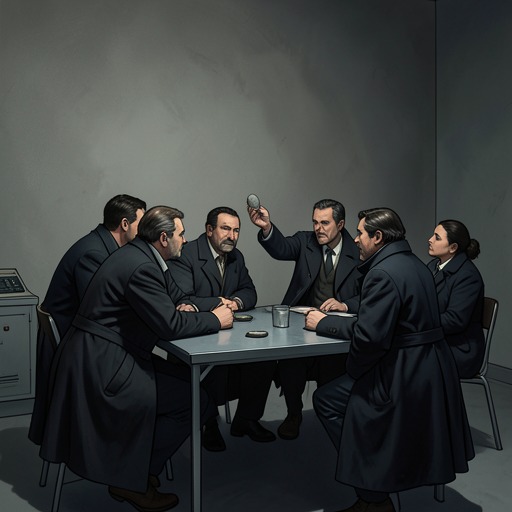
Shani Edmonds Is Taken Away and Freed
The Other Black GirlShani Edmonds’s removal and release mark a turning point in the struggle over what the Resistance knows, what it can prove, and when it is willing to act. The event reaches Nella Rogers first as a clue in Richard Wagner’s records: a dated sighting connects Kendra Rae Phillips, Shani’s missing phone, and the car that carried Shani away. Shani’s later account supplies the other half of the sequence, explaining that Kendra helped obtain her release and that the rescue came with an expectation of silence.
The dated clue
Nella discovers the account while examining photographs and handwritten notes associated with Kendra. The photo appears to be one of the editor’s last public images, perhaps taken around the publication of Burning Heart. Notes in Richard Wagner’s handwriting range from the 1980s to the present, turning a personal file into a record of prolonged tracking. One entry, dated October 20, 2018, places Kendra near the Intersection of 100th Street and Broadway, says that she took Shani’s phone, and records that she then went underground.
The note does not itself explain the car, the reason Shani was taken, or what happened to her afterward. Nella connects it to an event she has not witnessed: she remembers Shani being put into a black sedan and realizes that Shani was the person in it. The inference is immediate and personal, but its documentary basis is precise. The date and location in the file align with the disappearance; the note’s reference to the phone links Kendra to Shani at the critical moment. Nella’s fear comes from recognizing that the file has turned an apparent disappearance into a traceable sequence.
Taken away and released
The available accounts establish the outline rather than a full, continuous scene. On October 20, Kendra was sighted near Broadway, took Shani’s phone, and went underground. Shani was taken away in a black sedan. Nella’s discovery identifies Shani as the person inside it, while Shani’s subsequent account indicates that Kendra later persuaded someone involved to let her go. The evidence therefore connects Kendra both to the circumstances of Shani’s disappearance and to her return, without establishing who drove the sedan, who held Shani, or the precise means by which Kendra arranged her release.
The release did not restore Shani to an uncomplicated position of safety or freedom. Kendra’s terms, as Shani understood them, were reciprocal: if the Resistance left the others alone, they would leave the Resistance alone, and matters would remain quiet. Shani believed she owed Kendra for intervening on her behalf. That debt shaped what came next: even when Shani had material ready to disclose, she held it back rather than acting on her own.
The evidence Shani keeps back
Three months later, Shani is preparing an exposé for Gwen. Its supporting material includes screenshots of conversations, a log of Nella’s sightings, and photographs. One image pairs a selfie Shani posted shortly before Eva said goodbye with a photo Shani had taken of Eva at Rise & Grind Café. Shani has also assembled a point-by-point account of how she escaped the OBG conflict without Lynn Johnson or Hazel-May McCall knowing where she had gone. The draft would make the concealed movements and connections visible to an outside reader; sending it would place the evidence beyond Shani’s private control, whether or not Gwen chose to publish it.
Lynn’s caution about sharing material before there is absolute proof gives Shani one reason to hesitate, but Shani distinguishes that general rule from the reason that actually stops her. Kendra’s intervention matters more. Shani remembers that Kendra had secured her release and promised a period of quiet; Shani therefore waits for further instruction. The decision shows how the event continues to govern Shani after the car is no longer part of the immediate crisis. Her evidence is not simply a report she can send at will: it is bound up with a bargain, a sense of obligation, and the Resistance’s judgment about timing.
A quiet interval, not an end
Shani’s recollection also reveals that Kendra’s confidence in the Resistance has weakened. In a conversation three months earlier, during a ride with an Uber driver, Kendra had said that it was too late to stop Diana Gordon and that Diana had been compromised for too long. She questioned whether the Resistance could get ahead of what was unfolding. Yet Kendra did not describe withdrawal as the only course. Her proposed strategy was to remain quiet temporarily, watch people like Hazel rise in their professions, and then cut the OBGs off from their supply. The plan makes Shani’s own silence part of a larger pause: the Resistance is waiting, not necessarily conceding.
That pause remains uncertain. Shani recalls Kendra as seeming ready to pull away from Lynn’s mission, while also remembering Kendra’s proposed longer-term strategy. Lynn, for her part, would have left Shani behind after what she considered a foolish action. Together, these details make Shani’s release a limited rescue rather than a resolution of the conflict. She is free to prepare a disclosure, but still bound by the promise that followed her release and by the unresolved question of when the Resistance will act.
The event is disclosed across two different forms of knowledge: Nella reads an institutional record that identifies the date, location, phone, and disappearance, while Shani’s retrospective account explains the release and its consequences. Neither account alone gives the full picture. The file supplies a trace that Shani’s silence had concealed; Shani’s account reveals that the trace belongs to a negotiated release and a continuing strategy. The gap between evidence and testimony is therefore part of the event’s significance: Nella can recognize what happened, but Shani alone can explain why she has not yet made the whole story public.